
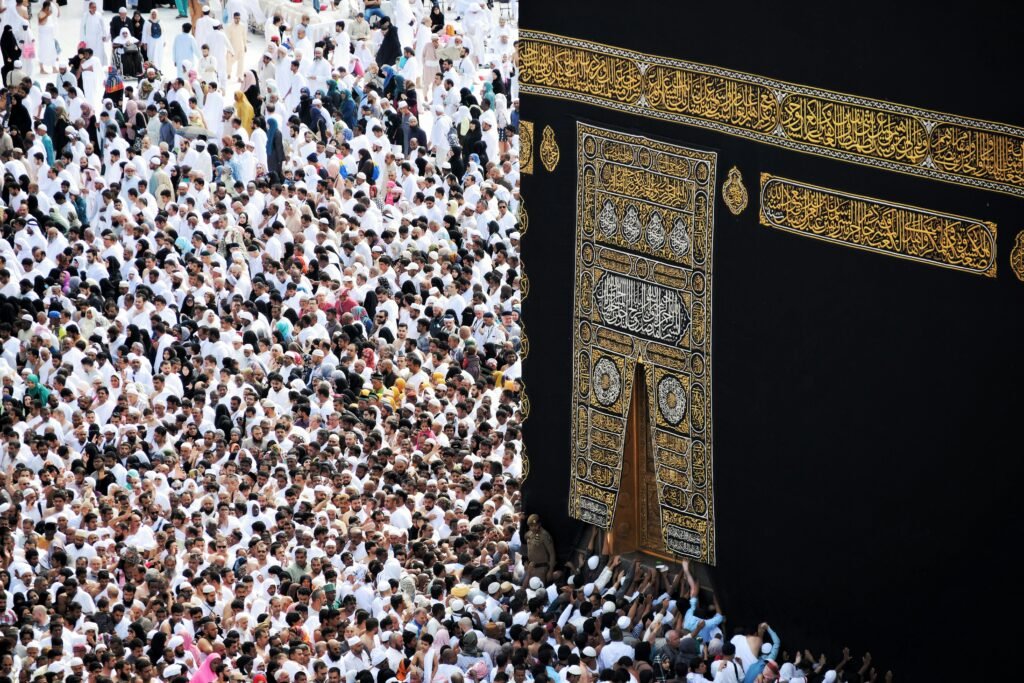
Islamic architecture is not only about beauty and form; it is deeply rooted in faith, symbolism, and divine purpose. At the very center of Islamic civilization stands the Kaaba, located in the Masjid al-Haram in Makkah, Saudi Arabia. Though simple in form, the Kaaba is the most powerful architectural symbol in Islam.
Simplicity with Profound Meaning
Architecturally, the Kaaba is a cube-shaped structure, approximately 15 meters high, built primarily from granite. Unlike many monumental religious structures, it does not rely on ornamentation, domes, or towering minarets. Its strength lies in intentional simplicity.
This simplicity reflects a core Islamic principle:
Tawhid — the oneness of Allah.
The Kaaba’s minimal form emphasizes unity, humility, and equality. Every Muslim, regardless of status or nationality, faces the same direction—Qibla—towards the Kaaba during prayer.
Geometry and Orientation
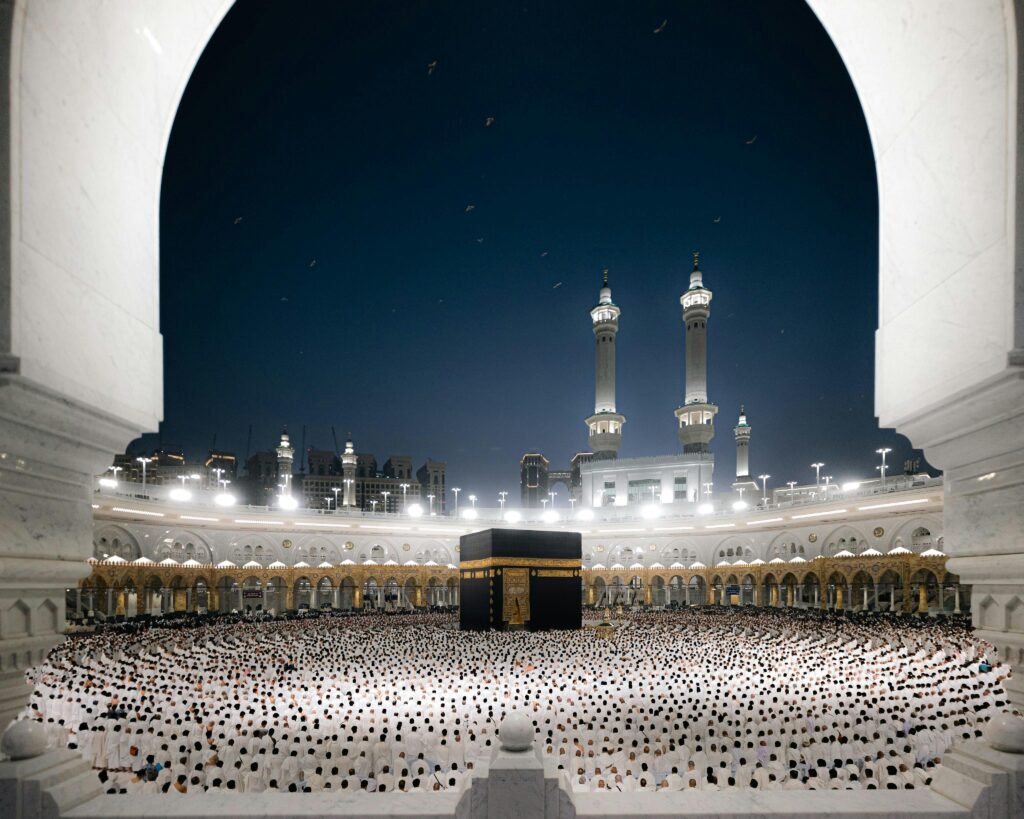
The Kaaba is a masterclass in spiritual geometry. Its cubic form represents stability and balance. The building is precisely oriented toward the cardinal directions, reinforcing order and cosmic harmony—an essential theme in Islamic architecture.
The act of Tawaf, where pilgrims circle the Kaaba seven times counterclockwise, transforms the structure into the center of a dynamic spatial experience. Architecture here is not static; it becomes movement, ritual, and devotion.
Materials and Sacred Elements
Several architectural elements enhance the Kaaba’s sacred identity:
- Kiswah: The black silk cloth embroidered with gold Quranic verses, replaced annually
- Hajar al-Aswad (Black Stone): Set into the eastern corner, marking the starting point of Tawaf
- Multazam and Hijr Ismail: Areas rich in spiritual and historical significance
These elements are not decorative in a conventional sense; they are functional symbols, connecting architecture to worship.
Influence on Islamic Architecture Worldwide
The Kaaba has profoundly influenced Islamic architecture across centuries. The orientation of mosques, the emphasis on geometry, and the idea of space as a medium for spiritual connection all trace back to it.
While mosques evolved with regional styles—Ottoman, Persian, Mughal, Andalusian—the concept of direction, unity, and sacred centrality remains consistent, rooted in the Kaaba.
Architecture Beyond Form
The Kaaba teaches a crucial lesson to architects and designers:
Architecture is not defined by complexity, but by purpose.
In an era of iconic skyscrapers and visual extravagance, the Kaaba stands as a reminder that meaning outweighs form, and that architecture can guide the human soul, not just the human eye.
Conclusion
The Kaaba is more than a building; it is the spiritual axis of Islam and a timeless example of how architecture can embody faith, unity, and divine order. Its enduring influence proves that the most powerful designs are often the simplest—when they are rooted in belief and purpose