
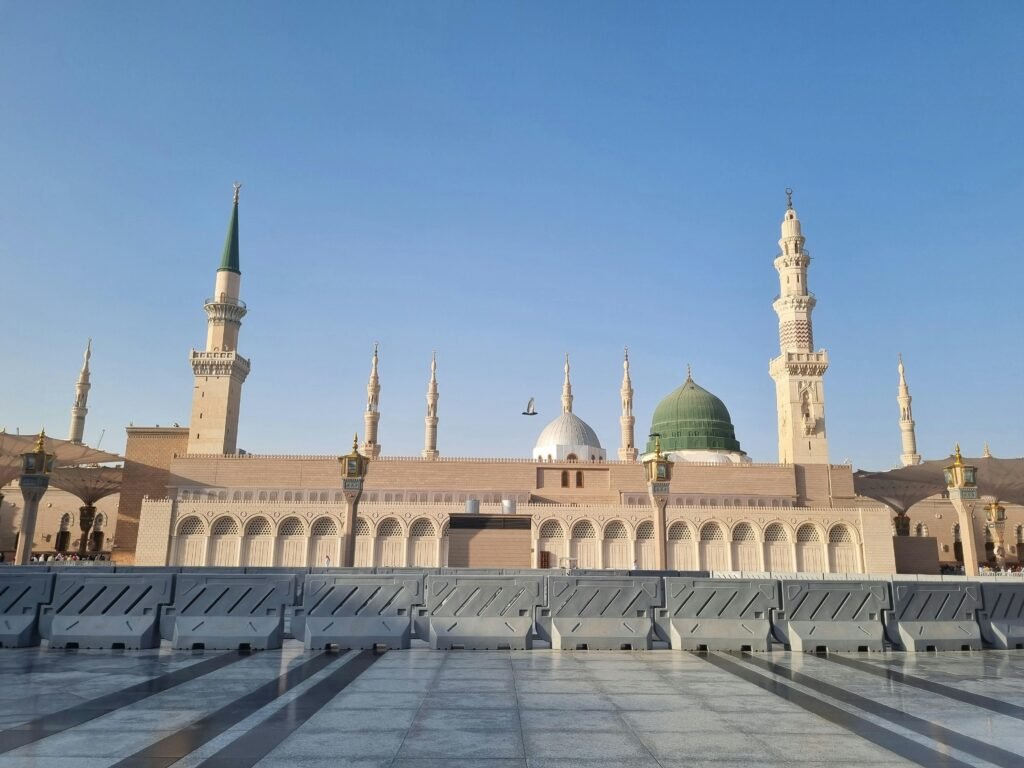
Madina al-Munawwarah is not only one of the holiest cities in Islam but also a living archive of early Islamic architecture. Unlike monumental cities built to showcase power, Madina’s architecture reflects simplicity, community, spirituality, and function—principles that later shaped Islamic architecture across the world.
Historical Background of Madina
Originally known as Yathrib, Madina became the heart of Islamic civilization after the Hijrah (migration) of Prophet Muhammad ﷺ in 622 CE. The city transformed from a tribal settlement into a structured Islamic society, where architecture played a crucial role in organizing religious, social, and civic life.
Madina was never planned as a grand imperial city. Instead, it grew organically around faith, equality, and community, making its architectural evolution deeply human-centered.
Al-Masjid an-Nabawi: The Architectural Core
The Prophet’s Mosque (Al-Masjid an-Nabawi) is the most important architectural landmark in Madina and a foundational reference for Islamic architecture.
Original Design
- Built using mud bricks, palm trunks, and palm-leaf roofing
- Open courtyard layout
- Multi-functional space for prayer, learning, governance, and community gatherings
- No ornamentation or hierarchy in space
This design introduced key architectural concepts:
- Mosque as a community nucleus
- Flexibility of space
- Equality in spatial experience
Architectural Evolution
Over centuries, the mosque expanded under various Islamic dynasties:
- Introduction of minarets
- Domes, including the iconic Green Dome
- Advanced structural systems and shaded colonnades
- Modern expansions integrating climate-responsive design and crowd management
Despite expansions, the mosque maintains its spiritual simplicity—a rare balance between scale and humility.
Residential Architecture of Madina
Traditional Madinan houses were designed with:
- Inner courtyards for privacy and ventilation
- Narrow streets for shade and social interaction
- Thick walls made of local materials to combat heat
- Clear separation between public and private zones
These elements strongly influenced Islamic residential architecture from Arabia to Andalusia and South Asia.
Urban Planning Principles in Madina
Madina introduced early Islamic urban principles:
- Mosque-centered planning
- Walkable neighborhoods
- Proximity between homes, markets, and worship spaces
- Emphasis on social justice and accessibility
Unlike Roman or Persian cities, Madina avoided monumental axes and instead focused on human-scale urbanism, a concept highly relevant to modern sustainable city design.
Influence on Global Islamic Architecture
The architectural philosophy of Madina influenced:
- Early mosques across the Islamic world
- Development of hypostyle mosque layouts
- Ethical design values: modesty, functionality, and inclusivity
- Integration of architecture with Islamic lifestyle and values
Even today, contemporary Islamic architects draw inspiration from Madina’s balance of spiritual depth and architectural restraint.
Lessons for Modern Architects
Madina teaches timeless lessons:
- Architecture is not about form alone, but purpose
- Community needs should shape design decisions
- Simplicity can carry profound meaning
- Spiritual architecture can coexist with modern technology
For architects and designers, Madina is a reminder that the most powerful architecture often begins with intention, humility, and service.
Conclusion
Madina’s architecture is not defined by luxury or dominance, but by faith, community, and clarity of purpose. It stands as a foundational model for Islamic architecture—one that continues to inspire architects seeking meaning beyond aesthetics.